The Sand Dollar Codex
The white disc on the beach is not a shell. It is the test, a fused internal skeleton about a millimeter thick, left behind by a dead animal that was in effect a flattened sea urchin: dark brown, purple, gray or green in life and covered top and bottom in short moving spines. On this coast the five-slotted one is Mellita tenuis, not the Atlantic species that nearly every source names.
The White Disc Is a Skeleton
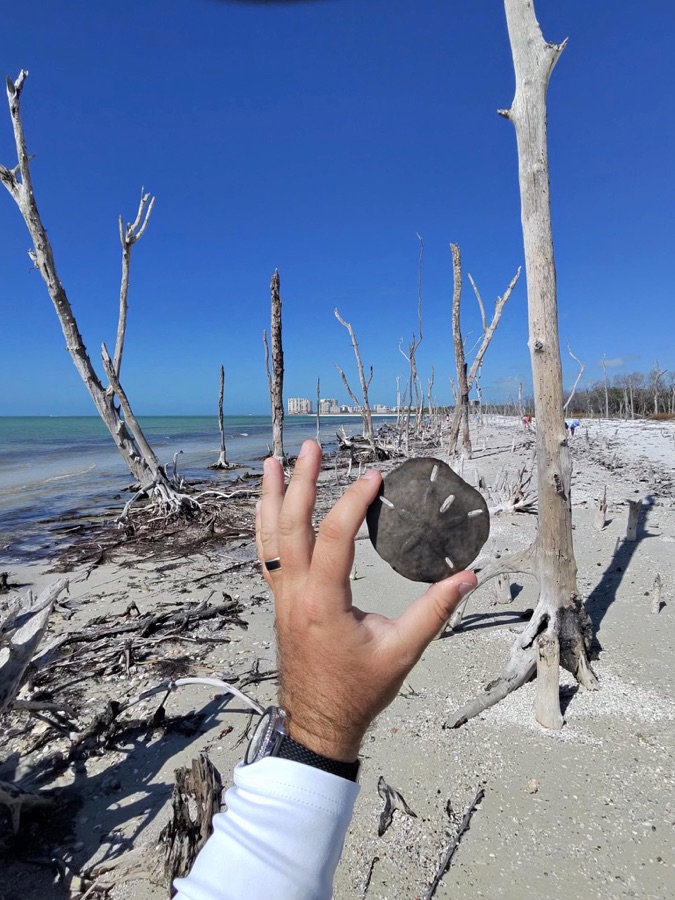
A sand dollar is an animal, and the white disc you found is what is left of it. That disc is the test: a skeleton of fused calcium carbonate plates, roughly a millimeter thick, that sat inside the living animal underneath its skin. Nothing ever lived inside it.
In life it was dark. Brown, purple, gray or green, covered top and bottom in dense short spines that move, and almost certainly worked down into the top layer of sand rather than sitting on it. Sand dollars are echinoderms in the class Echinoidea, which makes them sea urchins. They belong to the irregular echinoids: the body has gone flat and the symmetry has slid toward a front and a back, so unlike a globular urchin a sand dollar has a direction it travels in.
Everything below follows from those two facts. What you are holding is a skeleton, and the animal that grew it was an urchin. For the parts named one at a time, start with sand dollar anatomy.
The short version
- The white disc is the test, a fused internal skeleton roughly a millimeter thick. It is not a shell in the way a snail shell is.
- The Gulf's five-slotted species is Mellita tenuis H. L. Clark, 1940, WoRMS AphiaID 422503, type locality Sanibel Island.
- Mellita quinquiesperforata is the Atlantic species, Virginia to Brazil. It is not a synonym and it is the wrong name here.
- The five petals are the petalodium: pores for flattened tube feet used in gas exchange. Breathing structure, not feeding organ.
- A live sand dollar stains your palm yellow within about a minute. The pigment is echinochrome and it is harmless.
- Sand dollars are echinoderms, not mollusks, so their names live in the World Register of Marine Species rather than MolluscaBase.
The Name Almost Every Source Gets Wrong
The five-slotted sand dollar on this coast is Mellita tenuis H. L. Clark, 1940. It was described from a type locality at Sanibel Island, a Gulf beach up the coast from us, and it ranges from Louisiana to west Florida.
What you will read nearly everywhere else is Mellita quinquiesperforata (Leske, 1778). That is the Atlantic species, Virginia to Brazil. It is not a synonym of the Gulf animal and it is the wrong name for a Marco Island beach, yet it sits on museum labels, field guides, tour pages and most of the first page of search results. A name from 1778 has a long head start, and popular writing copies popular writing.
One practical note if you go checking names yourself. MolluscaBase is the right authority for a whelk or a conch and it is no help at all here, because a sand dollar is not a mollusk. For an echinoderm you want the wider World Register of Marine Species. The full case sits on the Mellita tenuis page.
Alive or Dead, Settled in About a Minute
Color first. Brown, purple, gray or green means alive, or dead very recently. Bone white means long gone. Texture second: a live animal feels like stiff felt and you can watch the pile shift under a fingertip, while a bare test is hard and finely stippled where the spines used to attach.
Then the check that settles it. Hold a live one flat on a dry palm and within about a minute it leaves a yellow stain. The pigment is echinochrome, it is harmless to you, and a bleached test will never do it.
The case people get wrong is the freshly dead one: still dark, still furred, not moving at all. If two of the three checks say alive, treat it as alive and set it back in the water, flat side down. Being wrong one way costs you a souvenir. Being wrong the other way costs an animal. Our full sand dollar overview walks the same checks with more room.
The Parts You Can Name on a Bare Test
Turn a test over and it stops being a blank disc. The five-petal figure on top is the petalodium, a field of paired pores through which flattened tube feet pushed out into the water. That is a gas exchange surface. The petals are how the animal breathed, not how it ate, and they get a page of their own.
The slots cut clean through the test are lunules. On the underside, fine branching channels called food grooves run inward to the peristome, the mouth, dead center. Near the margin of that same underside is the periproct, the anal opening, which surprises nearly everyone who learns it.
Shake a broken one and five small pieces rattle loose, each shaped like a bird with folded wings. Those are the jaw pyramids of Aristotle's lantern, the feeding apparatus. Folklore calls them doves. They are teeth.
Route One: The Animal While It Was Alive
Five pages cover the living animal. These are the ones that change how the disc reads in your hand.
- How a sand dollar eats: detritus and diatoms, moved by cilia and mucus along the food grooves to the central mouth, and why juveniles swallow sand grains as ballast.
- How a sand dollar moves: spines and tube feet working together to walk, to burrow into the top layer of sand, and to sit edge-on into a current.
- Sand dollar beds: they live in dense aggregations on sandy bottoms, at densities that can reach hundreds per square meter in some populations. A bed is not something to walk through.
- How long they live: six to ten years is a defensible general figure for echinoids, the best-aged case is a Pacific animal, and ours is unmeasured.
- Larvae that clone themselves: real, peer-reviewed, and done on a species that does not occur in Florida. The page names that species and stops there.
Route Two: The Object in Your Hand
Four pages take the test itself apart.
- Sand dollar anatomy: every named part, top and bottom, and why an internal skeleton behaves nothing like a shell.
- The five petals: the petalodium as a breathing structure, and the odd fact that echinoderm larvae are bilaterally symmetrical, so the five-part body is something the animal develops into rather than starts with.
- Aristotle's lantern: the five jaw pyramids, what they do while the animal is feeding, and how they come loose.
- Why they break: a wide, thin, rigid plate is close to the worst possible shape for surf, and a test that has rolled in the swash for a week is often fractured inside before anything shows outside.
Route Three: The Wider Family
The last route is names and kin, and it is where most of the errors live. Sand dollars are irregular echinoids, so their close relatives are sea urchins. Sea stars are class Asteroidea, and the connection runs only at the phylum level, Echinodermata, through shared features like pentaradial adult symmetry, a water vascular system and tube feet. "Starfish and sand dollars" is a gift shop pairing, not a family resemblance.
Nearby you may also meet Leodia sexiesperforata, the six-holed keyhole urchin, ranging North Carolina to Uruguay, and Encope michelini, whose US Fish and Wildlife Service common name is the Notched Sand Dollar. Sea biscuits in the genus Clypeaster share the order Clypeasteroida but are not sand dollars. "Arrowhead" is a vendor nickname used inconsistently across several animals, and "inflated" belongs to a sea biscuit rather than to any Encope. Two famous ones are not Florida animals at all: Echinarachnius parma is northern, Dendraster excentricus is Pacific.
The species page handles the naming in full, and the Florida shell identification guide covers whatever else came home in the bucket.
Three more pages sit off this route. The Encope problem is a live disagreement between a global register and a molecular study, and it is the best short explanation on this site of how a naming question actually gets settled. Sand dollars of the world covers what a traveler finds on other coasts, and which famous ones never turn up here. Fossil sand dollars puts the disc in your hand into deep time, on ground that is genuinely rich for it.
Empty Shells Only, and the Law Underneath It
Aboard our boat the rule is short and it is our own: empty shells only. No live shells, no live sand dollars, no argument about whether a particular one looks mostly dead. It is the only version that is easy to follow with wet hands and children on board.
The law underneath it is more interesting than the rule. Florida statute 379.101(34) defines "saltwater fish" to include living mollusks and echinoderms and expressly excludes nonliving shells. That one sentence is why a live sand dollar needs a Florida recreational saltwater fishing license and an empty test needs nothing. On City of Marco Island beaches, live shelling is separately prohibited by city code section 54-36(o), and section 54-36(k) bans removing sand from the beach.
Whether any numeric collecting limit applies to sand dollars in Florida is genuinely unsettled. Two independent readings of the rules came back disagreeing with each other, so we publish no number and have asked FWC in writing. Collecting is prohibited outright in Florida State Parks, Everglades National Park and Ten Thousand Islands National Wildlife Refuge. We run three tour windows a day out of San Marco Marina in Goodland, and you can book a trip here.
Every page in the codex
Questions people actually ask
What is a sand dollar?
It is an animal: an echinoderm in the class Echinoidea, which makes it a sea urchin, specifically a flattened irregular urchin with a front and a back. It lives worked down into the top layer of sandy bottom, feeding on fine organic material. The white disc people collect is only its skeleton, called the test, after the animal has died and bleached.
Is a sand dollar a shell?
No. A snail builds its shell outside its body and lives inside it. A sand dollar grows a fused plate skeleton, roughly a millimeter thick, inside its body underneath the skin and spines. That skeleton is the test. When the animal dies, the skin, spines and pigment break down and wash away, and the white disc left behind is the internal frame.
What is the correct scientific name for a Gulf of Mexico sand dollar?
The five-slotted one is Mellita tenuis H. L. Clark, 1940, type locality Sanibel Island, ranging Louisiana to west Florida. Most sources use Mellita quinquiesperforata instead. That is the Atlantic species, Virginia to Brazil, and it is not a synonym of the Gulf animal. Because sand dollars are not mollusks, check echinoderm names in the World Register of Marine Species rather than MolluscaBase.
How do you tell if a sand dollar is alive?
Three checks, about a minute. Color: a live one is brown, purple, gray or green, never white. Texture: a live one is furred with dense short spines that move, while a bare test is hard and finely stippled. The stain: a live animal leaves harmless yellow echinochrome pigment on your palm within about a minute, and a bleached test never will. Two of three saying alive means alive.
Are sand dollars related to starfish?
Distantly. Both are echinoderms, so they share pentaradial adult symmetry, a water vascular system and tube feet, but sea stars are class Asteroidea and sand dollars are class Echinoidea. The relationship is at the phylum level only. A sand dollar's actual close relatives are sea urchins, which most casual sources get backward by pairing starfish and sand dollars as cousins.
What are the pieces that rattle inside a broken sand dollar?
They are the five jaw pyramids of Aristotle's lantern, the feeding apparatus that sits inside the animal around its mouth. Sea urchins have the same structure, which is a good clue to what a sand dollar really is. When a dried test cracks, the connective tissue is long gone and the pieces knock around loose. Folklore calls them doves. They are teeth.
Where this comes from
Every factual claim on this page traces to a published source. Where the science or the law is genuinely unsettled, we say so on the page rather than pick the tidier answer.
Come find them with us
Three trips a day out of Goodland, into water the road does not reach. Captain-led, family-friendly, and timed to the tide.