
Sand Dollar Anatomy: What Every Part Is, and What It Did
The white disc is a test: a fused, plated internal skeleton roughly a millimeter thick, which in life sat under skin, spines and moving tube feet. The five petals on top are a field of breathing pores, the slots through the disc are lunules, and the underside carries the food grooves, the central mouth and, out near the rim, the anal opening. Almost everything worth knowing about the living animal is readable from the bare test once you know what the parts are called.
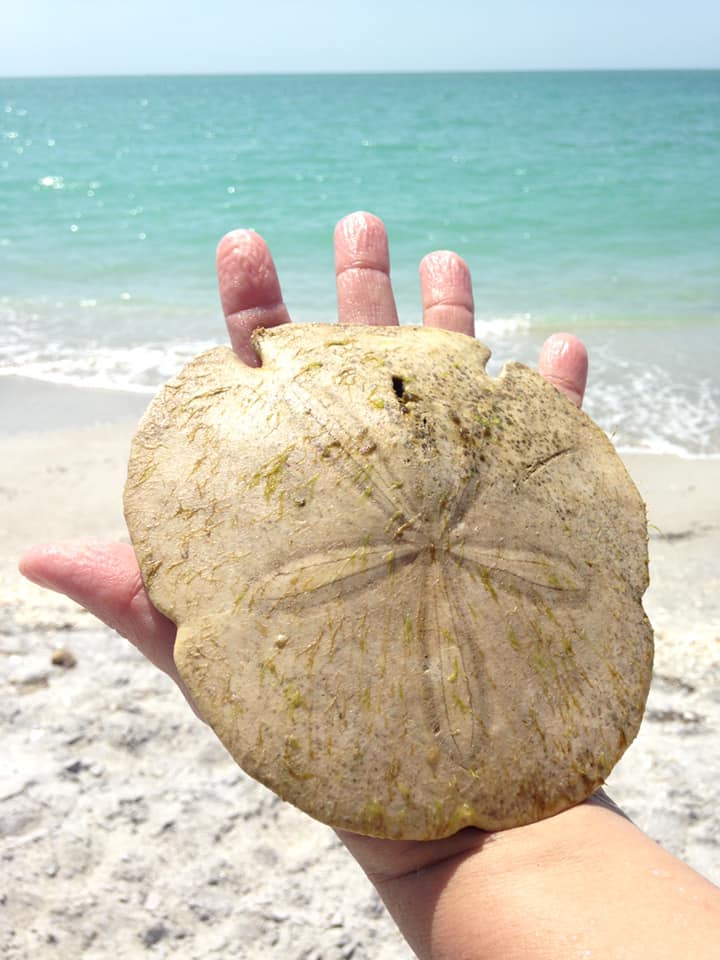
A Skeleton, Not a Shell
Set a sand dollar on your palm. What you are holding is a test: one rigid disc built from many small calcium carbonate plates that grew together at their edges until the joins locked. It is an internal skeleton. In life it sat under the animal's skin, the way your own ribs sit under yours, and it was never the outside of anything.
That distinction does more work than it sounds like it does. A snail's shell is a house. A fleshy organ called the mantle builds it from the edge outward, it is thick for its size, and it is meant to take a beating. A test is a frame, roughly a millimeter thick, braced in life from every direction at once: by skin, by muscle, by internal fluid, by a coat of short spines that spread any knock across the whole surface before it reached the plates.
All of that support is gone by the time the disc is white. What is left is the thinnest, most brittle version of this animal that has ever existed, and it is being asked to survive a canvas bag. Say skeleton instead of shell and you carry it differently.
The short version
- The white disc is the test: a fused, plated internal skeleton roughly a millimeter thick, not a shell in the sense a snail shell is.
- The five-petal figure on top is the petalodium, a field of pore pairs for flattened tube feet used in gas exchange, not for feeding.
- The slots through the disc are lunules and are original anatomy. Mellita tenuis has five; Leodia sexiesperforata, the six-holed keyhole urchin, has six.
- The mouth, the peristome, is at the dead center of the underside. The anal opening, the periproct, is also on the underside, out near the margin.
- The food grooves on the underside carried detritus and diatoms inward to the mouth in mucus, moved by beating cilia.
- Aristotle's lantern, the five jaw pyramids of the feeding apparatus, sits just inside the mouth and is what rattles in a broken test.
Top, Bottom, Front and Back
There are two faces, and most people only ever look at one of them. The aboral surface is the top: the slightly domed side that faced open water, the side the five petals are on, and the side that ends up in every photograph.
The oral surface is the underside, the flatter side that lay against the sand. Oral, because that is where the mouth is. Nearly everything this animal did for a living happened down there, and nearly nobody turns it over.
There is a third direction people miss entirely. A sand dollar is an irregular echinoid, which is the formal way of saying it has a front and a back. Globular sea urchins are the regular ones: mouth down, waste out the top, no preferred direction of travel. Sand dollars gave that up. They flattened out and took a heading, and the evidence is a small opening near one edge of the underside that you will meet further down this page. Find it and you know which end went first.
Every Named Part on a Bare Test
Here is the whole vocabulary in one place. Nothing in this table needs a microscope. Every entry is something you can put a fingertip on right now, or, for the soft parts that rotted away, something whose attachment point you can.
| Part | Where to find it | What it did |
|---|---|---|
| Test | The whole disc in your hand | The fused, plated internal skeleton, roughly a millimeter thick. Held the animal's shape and carried every other part. |
| Aboral surface | The slightly domed top | The side that faced open water. Carries the petal figure. |
| Oral surface | The flatter underside | The working side. Carries the mouth, the food grooves and the anal opening. |
| Petalodium | Centered on the top | The five-petal figure. A field of pore pairs for flattened tube feet used in gas exchange. A breathing structure, not a feeding one. |
| Pore pairs | The fine paired dots inside each petal | Each pair passed one flattened tube foot out through the test. |
| Apical system | The point all five petals radiate from | A small cluster of plates carrying the water intake and the pores that eggs and sperm left by. |
| Madreporite | Within the apical system | The sieve plate where seawater entered the water vascular system that powered every tube foot on the animal. |
| Lunules | The slots cut clean through the disc | Original openings, not damage. Five in Mellita tenuis, six in Leodia sexiesperforata. |
| Margin | The rim, all the way around | The thin tapering edge of the test, and the part your fingers land on when you pick one up. |
| Tubercles | The fine rounded bumps over the whole surface | Each one was the base of a single spine. |
| Spines | Standing on every tubercle, in life | Short, dense and movable. Did the burrowing, the moving and much of the food handling. Absent from any white test. |
| Tube feet | Out through the pores, in life | Gas exchange in the petals. Grip and food handling underneath. All of them run by the water vascular system. |
| Food grooves | Branching across the underside | Shallow channels lined with beating cilia that carried food particles in mucus inward to the mouth. |
| Peristome | The central opening on the underside | The mouth. |
| Aristotle's lantern | Inside the test, just behind the mouth | The feeding apparatus: five jaw pyramids. These are the loose pieces that rattle in a broken test. |
| Periproct | On the underside, out near the margin | The anal opening. Marks the animal's trailing end. |
| Internal supports | Inside, visible only in a broken test | Small pillars of the same material tying the top and bottom plates to each other. |
The rest of this page walks those entries in the order you would meet them.
The Petalodium, and What the Petals Are Actually For
The five-petal figure on the top surface has a name. It is the petalodium, and it is neither a decoration nor a flower. Look closely at a single petal and you will see it is drawn out of two fine rows of paired holes that run outward from the center and then curve back toward it, so each petal closes at its tip instead of running on to the edge.
Every one of those pairs passed a single flattened tube foot out through the test. Those tube feet were thin, broad and full of fluid, and their job was gas exchange. The petalodium is this animal's breathing surface, laid out flat across the top of the disc where the water was. It has nothing to do with feeding, which is the commonest thing people get wrong about a sand dollar.
Why five, and why the figure is so consistent from one animal to the next, is its own subject. We gave the petals a page of their own.
The Small Plate at the Center of the Petals
Follow the petals inward to the point they all radiate from. There is a small group of plates sitting there, the apical system, and it repays a close look because two completely different jobs are crowded into it.
The first is intake. A perforated plate called the madreporite is where seawater entered the water vascular system, the pressurized fluid network that echinoderms run instead of blood, and which powers every tube foot on the animal. Everything the petals did, and everything the tube feet underneath did, started at that one plate.
The second is reproduction. A few slightly larger pores in the same cluster are where eggs or sperm left the body. Sand dollars are broadcast spawners: they release into open water, fertilization happens out there, and the young start life as a swimming larva called an echinopluteus, which looks nothing like the disc on your palm.
The Lunules Are Supposed to Be There
The slots cut clean through the disc are lunules. They are original equipment. Telling a lunule from a hole knocked through by the surf is most of what people get wrong when judging whether a test is intact.
A lunule has a finished edge. The test closes smoothly around it, the rim is rounded rather than snapped, and it sits in a fixed position that follows the animal's five-part plan. Damage does none of that. A break has a raw edge, and it lands wherever the impact happened to land.
Count them, because the number is a species character rather than an accident. The Gulf animal on our beaches is Mellita tenuis, the five-slotted sand dollar, and five is what you should find. Leodia sexiesperforata, the six-holed keyhole urchin, has six and also occurs here. Encope michelini, whose US Fish and Wildlife Service common name is the Notched Sand Dollar, is named for a notch rather than for a count at all.
Turn It Over: The Side Nobody Looks At
Now flip the disc. The underside is the flatter face, and the first thing you should see is a pattern of fine grooves running outward from the middle, small channels feeding into larger ones like a river system drawn backward. Those are the food grooves.
They are shallow channels in the surface of the test itself. In life they were lined with beating hairs called cilia and slicked with mucus. Detritus and diatoms, the single-celled algae, got caught by the spines out of the sand and water, passed down into a groove, stuck to the mucus, and moved steadily inward. The grooves branch finer as they run toward the margin, and they follow the same five-part plan as the rest of the animal.
They all end in the same place. The opening at the dead center of the underside is the peristome: the mouth. Central, on the bottom, facing the sand it fed from. The full route from a grain of sediment to a meal is on the how they eat page.
The Periproct, Down by the Edge
Keep the disc turned over and look out near the rim. There is a second opening down there, smaller and easy to miss on a worn test. That is the periproct: the anal opening.
This is the part of sand dollar anatomy that reliably stops people mid-sentence. The mouth is in the middle of the bottom, and the back end is also on the bottom, out near the rim, a short distance from grooves that were carrying breakfast the other way. It reads as a design error until you remember how the animal lived.
It lived in the top layer of sand, moving slowly forward on its spines. The mouth is central underneath because food came at it from every side. The periproct is out at the margin because that margin is the trailing end: waste left behind the animal, and the animal kept moving away from it. In a globular sea urchin, which commits to no direction, the same opening is up on top. Sand dollars took a heading, and the plumbing moved to match.
Aristotle's Lantern, Still Inside
Pick up a whole test and tip it gently. If something rattles, the animal's jaws are still in there.
Aristotle's lantern is the feeding apparatus: five jaw pyramids, arranged around the mouth and sitting in a chamber just inside the peristome. In life muscle bound them together and worked them like a five-part beak. They are made of the same calcium carbonate as the test, so they survive when the soft tissue does not, and once the muscle rots the pyramids come loose. That is what you are hearing.
Find one the sea has already opened and the pyramids drop out as small pale wedges. Folklore calls them doves. What they really are, and where that story came from, is its own page.
Spines and Tube Feet: The Animal That Is Missing
Run a thumb across a clean test. It is not smooth. The entire surface, top and bottom, is finely covered in small rounded bumps called tubercles, and every single one of them carried a spine.
That is the animal you are not holding. A living sand dollar is dark: brown, purple, gray or green, and completely furred in short movable spines, each one swiveling on its own bump under muscle. Touch a live one and it feels like felt, with the pile shifting under your fingertip. The spines did the walking, the burrowing and a fair amount of the food handling, working with tube feet that came out through pores on the underside.
So a bare test is a map of an animal with the moving parts subtracted. The bumps tell you where the spines were. The pore pairs tell you where the breathing tube feet came out. The grooves tell you which way lunch was traveling. None of that is legible on a snail shell.
Five Parts in the Adult, Two Sides in the Larva
Everything on the disc is arranged in fives: five petals, five jaw pyramids, food grooves laid out in five. The formal term is pentaradial symmetry, five-part radial symmetry, and it is the feature that ties sand dollars to sea urchins, sea stars and sea cucumbers inside the phylum Echinodermata.
Here is the part left out of nearly every account. The animal did not start out that way. Echinoderm larvae are bilaterally symmetrical: a left side and a right side, like yours, swimming in the plankton. The five-part body is something the animal builds during development, out of a two-sided beginning. Radial symmetry here is a destination, not a starting condition.
Then the sand dollar partly walks it back. By taking on a front and a back as an adult, it puts a single axis into a five-part body, which is why the anal opening ended up at one margin instead of in the center of the top. The disc on your palm came from a two-sided larva, became five-part, and then relearned a direction.
Reading Damage and Wear
A test keeps a record of what happened to it. Once you can name the parts, the marks read like a short history of the object.
Color. A very recently dead animal is not white. It is tan, greenish or gray, sometimes still faintly velvety where a few spines hang on. White is the end state, reached after sun and surf take the organic material out. If the disc is dark, furred and staining your palm yellow, it is a live animal: the alive or dead check takes about a minute.
Break edges. A fresh break is sharp, chalky and bright, and usually means the test came apart in the last stretch of surf or in the bottom of a bag. An old break is rounded and faintly polished, because the sea has been working on it since.
Surface. Newly bleached: finely stippled with tubercles, petals crisply drawn. Worn: smooth, dull, the pore pairs opening up as the plate surface goes. Far gone: the joins between plates begin to show as fine lines across the disc, because the test is coming apart along the seams it was built from.
Holes. Rounded rim, fixed position, matching the species: lunule. Raw rim anywhere else: damage. The commonest damage is a chunk gone from the margin, which tapers to almost nothing, or a caved patch on the underside.
Dark staining. Gray or black is usually iron sulfide picked up while the test lay buried in oxygen-poor mud, and that can happen to something that died recently. Black does not mean fossil.
Why so many arrive already broken is a separate subject.
Handling One Once You Know What It Is
Knowing the parts changes the handling, because now you know where the weak ground is.
Carry a whole test flat on an open palm, or alone in the bottom of a container, rather than pinched between finger and thumb at the rim. The margin is the thinnest part of the disc and it is exactly where a grip lands. Do not press the middle of the underside. Do not drop a test loose into a bag with heavy shells, because the shells win. If it rattles, the lantern is loose in there, and every knock moves it around inside a container about a millimeter thick.
One rule of ours, stated as ours rather than quoted at you as law: empty only. If the disc is dark, furred and staining, it is a living animal, and it goes back where it came from, right side up, into wet sand. What Florida permits a person to carry home is genuinely unsettled between two defensible readings of the state's rules. We have asked the Florida Fish and Wildlife Conservation Commission in writing, and until their answer is in hand, nobody should be quoting you a number. The anatomy, though, we are glad to go through out on the water, with a wet one in hand and the tide going out.
Questions people actually ask
What is the difference between a sand dollar test and a shell?
A snail builds its shell on the outside of its body, adding material at the opening, and lives inside it. A sand dollar's test is an internal skeleton: many small calcium carbonate plates that fused into one rigid disc underneath the animal's skin. It is roughly a millimeter thick, and in life it was braced by skin, muscle, internal fluid and a full coat of spines. Bare and dry, it has none of that support left.
What are the holes in a sand dollar?
The slots cut cleanly through the disc are lunules, and they are original anatomy rather than damage. You can tell by the rim: a lunule has a finished, rounded edge and a fixed position, while a break has a raw edge and lands wherever the impact did. Mellita tenuis, the Gulf's five-slotted sand dollar, has five. Leodia sexiesperforata, the six-holed keyhole urchin, has six.
Where is a sand dollar's mouth?
At the dead center of the underside. The opening is called the peristome, and the fine grooves branching across the underside all run into it. Just inside it sits Aristotle's lantern, the five jaw pyramids the animal fed with. If you have only ever looked at the petal side, you have never seen the mouth, which is true of most people who have handled one.
What is the small hole near the edge on the underside of a sand dollar?
That is the periproct, the anal opening. It surprises people, because it sits on the same face as the mouth and not far from the food grooves that were carrying food the other way. It is there because a sand dollar has a front and a back: it lies in sand and moves forward, so the trailing margin is where waste left. In globular sea urchins, which commit to no direction, the same opening is on top.
What are the lines on the underside of a sand dollar?
Food grooves. They are shallow channels in the surface of the test that branch outward from the mouth toward the margin, following the animal's five-part plan. In life they were lined with beating cilia and coated in mucus, and they carried detritus and diatoms steadily inward to the mouth. They are the clearest evidence on the whole test that the underside was the working side.
What are the bumps all over a sand dollar test?
Tubercles. Each rounded bump was the base of one spine, and a living sand dollar carries them over the entire surface, top and bottom, with a short movable spine standing on every one. The spines did the burrowing, the moving and much of the food handling. On a bare test the tubercles are what make the surface feel finely stippled instead of smooth.
How thick is a sand dollar test?
Roughly a millimeter, and that is most of the answer to why they break so easily. The disc is wide, thin and rigid, and in life every load on it was spread out by skin, spines and internal fluid pressure. Take all of that away and dry it out, and you have a brittle plate with nothing left to absorb a knock. Carry it flat, and carry it by itself.
Where this comes from
Every factual claim on this page traces to a published source. Where the science or the law is genuinely unsettled, we say so on the page rather than pick the tidier answer.
Come find them with us
Three trips a day out of Goodland, into water the road does not reach. Captain-led, family-friendly, and timed to the tide.