
Why a Sand Dollar Has Five Petals
The five-petal figure has a name, the petalodium, and it is a breathing surface. Each petal is a field of paired pores through which flattened tube feet reach into the water and exchange gas. There are five because every echinoderm builds its adult body on five-part symmetry, and the petals outlast every other marking on a test because the pores go through the plate instead of being scored into its surface.
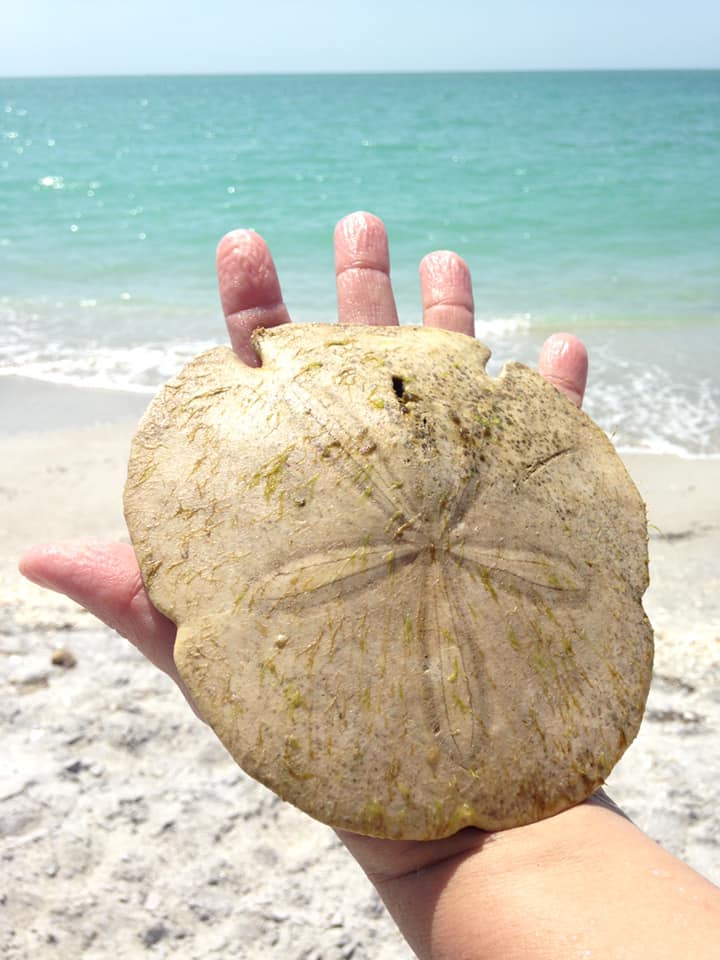
The Figure Has a Name
The pattern on top of a sand dollar is called the petalodium, and each of the five arms of it is a petal. That is the technical term, not a nickname borrowed from botany. Learning it is the fastest way to stop reading the figure as a picture printed on the animal.
Every sea urchin, sand dollar included, is built around five bands called ambulacra. They run from the mouth outward to the top of the animal and they carry its tube feet. In a globular urchin those bands stay about the same width the whole way. In a sand dollar, the stretch of each band on the upper surface has widened and shortened into a leaf shape while the rest of the band stayed narrow. Widen five stripes in their middles and you have drawn a flower. Nothing was added to make the figure. A structure all urchins have was reshaped.
The five petals meet at the center of the disc in a small plated area called the apical system. The rest of the named parts of a bare test are laid out on the anatomy page.
The short version
- The five-petal figure is the petalodium. Each petal is the widened upper part of one of the five ambulacra that every sea urchin has.
- The pores are openings for flattened tube feet used in gas exchange. The petalodium is a breathing surface, not a feeding organ and not decoration.
- There are five because echinoderms are pentaradial. The larva, an echinopluteus, is bilaterally symmetrical, so five-part symmetry is built during development rather than present from the start.
- The petals survive wear better than anything else on a test because the pores pierce a plate about a millimeter thick instead of being scored into its surface.
- Slot count and petal count are independent. Leodia sexiesperforata has six slots through the test and still five petals.
- The petals will not get you to species on this coast. The Gulf and Atlantic Mellita question is settled by range and taxonomy, not by the figure on top.
What the Pores Actually Are
Look at a petal through a hand lens. It is not a solid mark. It is two rows of small holes, and the holes come in pairs. The pairs are largest near the middle of the petal and get finer toward the outer end, where the rows converge, the petal narrows, and in many sand dollars it very nearly closes.
A pair is one opening for one tube foot, not two feet. The standard functional reading of a double pore is that fluid from inside the animal runs out into the foot through one hole and returns through the other, so the foot has a circuit through it instead of a dead end.
The middle of the figure is a different thing again. The apical system carries the madreporite, a perforated plate that is the one place the animal's internal water vascular system opens to the sea. The genital pores open in the same small area. If you assumed the petal pores were where a sand dollar takes water in, that job belongs to the plate in the center.
The Petals Are a Breathing Surface
A tube foot pushed out through a petal pore looks nothing like the short stubby feet on the underside. It is flattened, thin walled and broad, closer to a leaf than to a finger.
That shape gives the function away. A gas exchange surface wants as much area as possible and as little material as possible between the water outside and the fluid inside. Flat and thin does both. Oxygen crosses into the fluid of the water vascular system and the body cavity, carbon dioxide crosses back out. There is no blood here, no heart, and no gills in the sense a fish has gills. The petalodium is as close as a sand dollar gets to one.
Position follows function. A sand dollar spends its life worked into the top layer of sand, and the water above it is where the oxygen is. Oxygen runs out quickly in the sediment underneath. So the animal keeps its breathing surface on the face that looks up and its food handling on the face pressed into the sand. One flat body, two jobs, sorted by which way each face points.
Not a Mouth, Not a Foot, Not a Flower
Three things the petals are not.
- Not where it eats. The mouth is on the underside, dead center, and food reaches it along fine branched channels called food grooves, moved by cilia on a thread of mucus. All of that is on the bottom of the animal, and the petalodium takes no part in it. The mechanics are on how a sand dollar eats.
- Not how it walks. Movement is spines plus the tube feet on the underside, not the flattened podia in the petals. See how a sand dollar moves and burrows.
- Not a picture of a flower. The resemblance is real, and it is a coincidence of geometry. Five things radiating from a center read as a bloom whether they are petals, spokes or ambulacra.
The reason to be blunt about the first one is that the flower reading and the mouth reading feed each other. Once a figure looks like a bloom, people expect it to open, and it is a short step from there to assuming something goes in. Nothing opens. The figure is perforated, and what comes through the perforations is breathing apparatus.
Why Five: It Is an Echinoderm Fact
Five is not really a sand dollar fact. It is an echinoderm fact, and the sand dollar inherited it.
Every living echinoderm builds its adult body on five-part radial symmetry: sea urchins, sand dollars, sea stars, brittle stars, sea cucumbers and the crinoids. Five ambulacra, alternating with five interambulacra, arranged around a central mouth. Some sea stars carry more than five arms, which is a variation on the plan rather than a replacement for it. Sea cucumbers are the hard case: the body is stretched along one axis until the arrangement is difficult to see, and it is still there in the rows running the length of the animal.
So a sand dollar has five petals because it has five ambulacra, and it has five ambulacra because it is an echinoderm. The petals are just the part of that arrangement that got wide enough to notice. It also explains why this animal is far closer kin to a sea urchin, which shares a class with it, than to a sea star, which shares only the phylum.
The Larva Was Not Five Sided
Here is the part that almost always gets left out. A sand dollar does not start out five-sided. It starts out with a left and a right, the way you do.
Sand dollars spawn into open water, and a fertilized egg becomes a small drifting larva called an echinopluteus. That larva is bilaterally symmetrical: paired arms held out on internal calcareous rods, a front, a back, and a mirror plane down the middle, feeding on single-celled algae in the plankton. Nothing about it looks like a sand dollar.
The five-part animal is built inside it. A structure called the adult rudiment develops on the left side of the larva, organized around part of the larval body cavity, and the pentaradial arrangement is laid out there, ambulacra included, while the larva is still swimming. At metamorphosis the juvenile settles to the bottom and most of the larval body is discarded.
So five-part symmetry in an adult echinoderm is developed, not original. The bilateral body came first and the animal grew out of it. Every petal you are looking at was assembled on the left-hand side of something that had a left-hand side.
And Then the Sides Come Back
A sand dollar is not a pinwheel. Turn a test over and you find it has a front and a back, which is exactly what a five-part radial animal is not supposed to have.
Sand dollars belong to the irregular echinoids. That branch flattened out, took up a direction of travel, and let a second, bilateral symmetry settle back over the radial one. The mouth stayed central on the underside, but the anal opening, the periproct, moved off center to sit near the margin underneath, which surprises nearly everyone who learns it. That opening marks the rear of the animal.
The petal figure follows the same axis. One petal lies on the midline and the other four fall into two mirrored pairs, so a mirror plane runs through the figure front to back. Once you can see that, you can orient any test in a second. Find the periproct near the margin on the underside, and the single petal lying opposite it points the way the animal was traveling. That is one of very few genuinely usable things the petals will tell you.
Why Five and Not Six, Honestly
Now the question underneath the question. Why did the group settle on five in the first place?
Nobody knows, and a page that tells you otherwise is guessing with confidence. Five-part symmetry is ancient and inherited: this animal has it because its ancestors had it. The fossil record of early echinoderms includes forms whose symmetry was not five-part, so five was arrived at rather than present from the beginning of the group.
You will meet an engineering argument for it. It is worth understanding without believing it too hard. With an odd number of radii, no ambulacrum sits directly opposite another one, so the sutures between plates are staggered rather than lined up, and no single joint line runs straight across the animal from edge to edge. In a rigid plated skeleton that is a sensible way to avoid building in a plane of weakness. It is a plausible story. It is not a demonstrated cause, and the same symmetry turns up in echinoderms that are not rigid boxes at all.
We would rather leave an open question open than close it with a tidy answer nobody has earned.
The Last Thing to Wear Away
Pick up a chalky, beach-worn test with no texture left on it and you will still see the petals. There is a mechanical reason for that, and it is the most useful thing on this page.
Almost everything else visible on a fresh test is worked into its surface. The fine bumps where the spines attached stand up from it. The food grooves on the underside are scored into it. Sand in moving water takes those off the way it takes anything off, from the outside in. The petal pores are different. They are holes through a plate about a millimeter thick. To erase a pore, abrasion has to remove the full thickness of the test at that spot, and long before that the test has broken.
So the order of loss is predictable: skin and spines first, then color, then the surface texture, then the grooves underneath, and the petals last of all. Which means a test showing petals and little else has been in the swash a long time, and a test that has been in the swash a long time is usually cracked inside where you cannot see it. That is the subject of why sand dollars break.
Reading a Worn One Without Fooling Yourself
The petals last, but they do not last unchanged, and this is where people talk themselves into an identification.
The tips go first. The pore pairs are finest and most closely set at the outer end of each petal, so wear takes the far end before it takes the middle, and a worn petal reads shorter, blunter and more open at the tip than the same petal did on the living animal. Argue about petal proportions using a beach-rolled test and part of what you are measuring is the beach.
Wear one far enough and the disc comes apart in a way worth knowing about. A test is not solid. Between its upper and lower surfaces sit internal supports holding the two apart, which is how something a millimeter thick stays rigid at all. When the outer layer finally goes, those show through as a coarse, open, honeycombed texture. A test in that condition will not survive a pocket.
One thing the petals will never tell you is whether the animal was alive when it was picked up. That is color, spines and the yellow echinochrome stain, covered on our main sand dollar page.
The Same Five Petals on Very Different Animals
The count does not change between species. The figure does. Keeping the two straight sorts out most of the confusion in a gift shop bin.
- Regular sea urchins have no petals at all. Their ambulacra run as even bands from the mouth to the top of the globe, so there is nothing leaf shaped to look at. A petalodium is a feature of the irregular urchins.
- Heart urchins, a different irregular group, sink the figure into grooves, and in many of them the front ambulacrum is not petal shaped, so the figure reads as four petals and a channel.
- Sea biscuits in the genus Clypeaster are not sand dollars, though they sit in the same order, Clypeasteroida. Their petals are broad and sit on a swollen dome instead of a flat plate. Clypeaster rosaceus is the inflated sea biscuit, Clypeaster subdepressus the flat one.
- The notched sand dollar, Encope michelini, still has five petals. What differs is the outline of the test, whose margin is notched rather than pierced by clean enclosed slots.
- The six-holed keyhole urchin, Leodia sexiesperforata, has six slots and five petals. Slot count and petal count are separate facts, and they get merged constantly because Mellita happens to have five of each.
One more, from a coast that is not ours. Dendraster excentricus carries its petal figure noticeably off center rather than in the middle of the disc, which is what the species name points at. It is a Pacific animal, Alaska to Baja, and does not occur in Florida, whatever a bag of craft supplies says.
What the Petals Can and Cannot Tell You
Genuinely useful in the field:
- That you are holding an echinoid, and an irregular one. Part of a petal on a broken chip is enough, which is how you tell a fragment of test from a piece of clam.
- Which way the animal faced, using the mirror plane and the periproct.
- What kind of animal, at group level. A figure on a thin flat disc is a sand dollar. The same figure on a thick dome is a sea biscuit.
Not useful, whatever a chart on a placemat implies:
- Species, on this coast. The five-slotted sand dollar here is Mellita tenuis, and the reason most sources call it something else has nothing to do with the figure on top. That argument is laid out on the Mellita page.
- Age, sex or condition. None of that is written into the petals.
- Pore counts. Counts of pore pairs appear in technical species descriptions, taken from measured specimens under magnification, and they change with the size of the animal. We have not verified a figure for our species, so we are not printing one. A count invented for a web page is exactly the kind of thing that gets copied for twenty years.
The Legend, Described and Not Reprinted
A printed card turns up in gift shops all along this coast, reading the sand dollar as a Christian symbol. In it the slots are wounds, the figure on top is an Easter lily, the pattern underneath a poinsettia, and the pieces that fall from a broken test are doves released. We describe it. We will not reprint it: its authorship is genuinely unknown, and we do not republish work when we cannot say whose it is.
Call it what it is. Folklore. A reading laid over the animal long after the animal existed, and a good one: it has kept people picking these up for generations.
It is also worth knowing what it merges. The two flowers in the story are two different structures on two different faces. The one on top is the petalodium, the breathing surface this whole page is about. The one underneath is the set of food grooves branching out from the mouth, and those really do carry food. The doves are jaw elements from Aristotle's lantern, which is to say teeth. The animal underneath the story is stranger than the story, and both of them fit in one hand.
We run three trips a day out of San Marco Marina in Goodland, and this is the kind of question a captain gets asked at the rail. You can book a trip, or send us a question if your test is doing something these paragraphs do not explain.
Questions people actually ask
What is the five-petal pattern on a sand dollar called?
The petalodium. Each of the five arms is a petal, and each petal is the widened upper section of one of the five ambulacra, the bands of tube-foot pores that every sea urchin carries. Nothing was added to the animal to make the figure. A structure common to all urchins was reshaped, which is why a globular sea urchin has the same five bands and no flower to show for them.
Why does a sand dollar have five petals and not four or six?
Because it is an echinoderm, and every living echinoderm builds its adult body on five-part symmetry. Five ambulacra, five petals. Why the group settled on five in the first place is not settled science. The symmetry is ancient and inherited, and the fossil record of early echinoderms includes forms that were not five-part. Explanations have been proposed. None of them is demonstrated.
Are the petals how a sand dollar eats?
No, and this is the most repeated error about the animal. The petals are a breathing surface. Flattened tube feet push out through the pores and exchange gas with the water. Feeding happens on the opposite face: the mouth is central on the underside, and food travels to it along branched food grooves on a thread of mucus. The petalodium takes no part in feeding.
Can you identify a sand dollar species from its petals?
Not on a beach, and not on this coast. The petals get you to group level. A figure on a thin flat disc is a sand dollar, the same figure on a thick dome is a sea biscuit. They will not separate the Gulf's Mellita tenuis from the Atlantic Mellita quinquiesperforata. That is settled by range and taxonomy, not by the figure on top, and wear makes petal shape less reliable rather than more.
Why can I still see the petals on a worn, chalky sand dollar?
Because the pores go through the test rather than being scored into its surface. Sand wears a surface off from the outside in, so the spine bumps, the color and the food grooves go first. To erase a petal, abrasion has to remove the full thickness of a plate about a millimeter thick, and the test almost always breaks before that happens. The petals are the last feature standing.
Do all sand dollars have exactly five petals?
Yes, and so do their close relatives, because five ambulacra come with being an echinoid. What changes between species is the shape and proportion of the figure, not the count. Leodia sexiesperforata has six slots through the test and still five petals. Encope michelini has notches at the margin and still five petals. Slot count and petal count are separate things that get merged constantly.
Is the sand dollar legend about the petals true?
It is folklore, not biology, and we describe it rather than reprint it because its authorship is unknown and its copyright cannot be cleared. The story reads the figure on top as an Easter lily and the pattern underneath as a poinsettia. Those are two different structures. The top is the petalodium, a breathing surface. The underside pattern is the food grooves. The pieces the story calls doves are jaw elements.
Where this comes from
Every factual claim on this page traces to a published source. Where the science or the law is genuinely unsettled, we say so on the page rather than pick the tidier answer.
Come find them with us
Three trips a day out of Goodland, into water the road does not reach. Captain-led, family-friendly, and timed to the tide.