
Why Sand Dollars Break So Easily
The white disc is a test: one fused skeleton of interlocking plates, roughly a millimeter thick. That shape carries pressure spread evenly across the whole disc and fails at a single point, which is why a pinch between thumb and finger snaps something that survived a winter in the surf. Most break in the water long before anyone sees them, and of the ones that reach your hand the two failures you actually control are handling pressure and drying, which is the stage people get wrong.
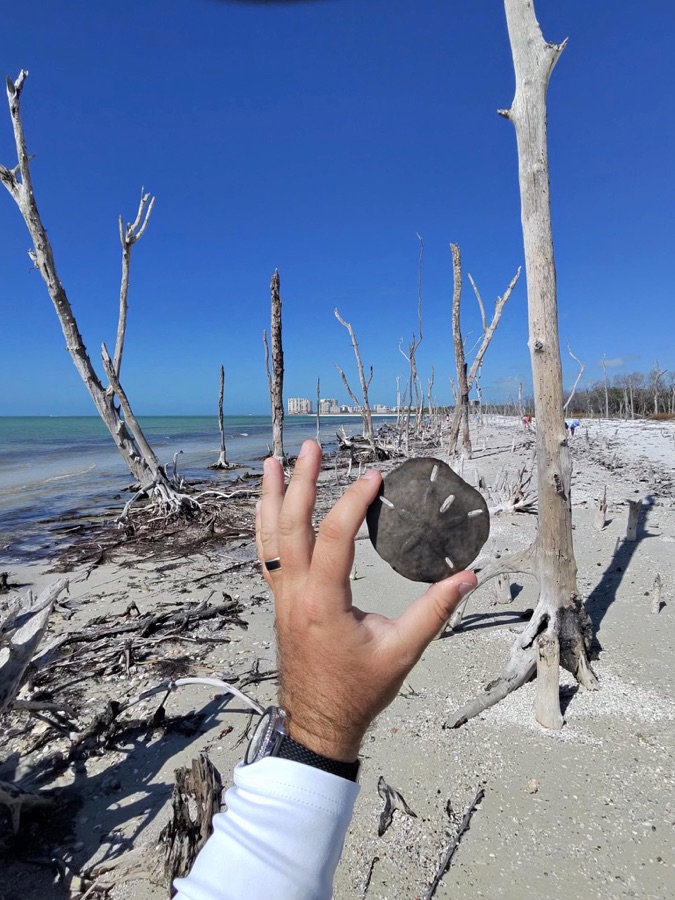
What you are actually holding
The white disc in your hand is a test. It is not a shell the way a whelk or a cockle is a shell. A snail builds its shell outside its body and lives inside it. A sand dollar builds its test inside its body, under a skin of tissue and dense short spines, and what you find on the sand is that skeleton after the animal died and the tissue washed away.
The test is one piece. It is built from many interlocking plates, but in a sand dollar those plates fuse into a single rigid structure, and the seams stay visible as fine lines across the surface. The wall is roughly a millimeter thick. That is the only number you need to understand everything else here. A millimeter of porous calcium carbonate, curved into a low dome, is doing all the work.
Porous matters. Echinoderm skeleton is not solid mineral. It is a fine open mesh, and in life that mesh is filled with living tissue. Dead, rinsed and dried, it is a stiff sponge of chalk: light for its size, and brittle. The anatomy page walks the whole structure part by part.
The short version
- The white disc is a test, a fused, plated internal skeleton roughly a millimeter thick, not a shell in the sense a snail shell is.
- A test is not simply hollow. Internal supports run between the upper and lower walls, and any broken one shows them.
- The lunules are the slots cut clean through the disc, and the five-petal petalodium is a field of pores for tube feet used in gas exchange.
- The loose pieces that rattle inside a broken test are the five jaw elements of Aristotle's lantern, the feeding apparatus. Folklore calls them doves.
- A wet test tolerates handling that a dry one does not, so the safest time to move a find is before it dries.
- A living sand dollar is brown, purple, gray or green with dense short moving spines, and stains your palm yellow with echinochrome within about a minute.
Strong in one direction, weak in another
A low dome of brittle material is an efficient shape. Push evenly on the whole surface and the load travels through the material as compression, which is what chalky minerals are good at. Buried in the top layer of sand, with grains packed against every part of the upper surface, a test sits under exactly that kind of even load, which is why they survive at all.
Now take it out of the sand and hold it between a thumb and a finger. The load that the sand spread across the entire disc is suddenly going through two contact patches the size of fingertips, on opposite faces, near the middle. Under a point load a thin plate does not compress. It bends. Brittle materials fail in bending long before they fail in compression, and they fail from the stretched face, the one bowing away from the pressure.
That is the whole of it. The geometry that lets a sand dollar sit out a winter on a sandbar is the same geometry that lets it snap in a grip that would not bruise a grape. You simply loaded it in the one direction it was never built for.
A test is not simply hollow
Break one open and the first surprise is that the space inside is not empty. Small pillars run between the upper wall and the lower wall, propping the two surfaces apart like posts under a floor.
Those props are why a test holds its shape at all. Without them a dome that wide and that thin would behave like a potato chip. With them, the two surfaces cannot move toward each other independently, and the disc works as one shallow box rather than as two loose sheets.
In life that space was full: gut, gonads, the water vascular system that runs the tube feet, and the feeding apparatus at the center. On a beach test all of it is gone. What is often in there instead is sand, worked in through the mouth opening and through the lunules, the slots that pierce the disc. That is why a dry test can be heavier than it looks and why it grinds faintly when you tilt it.
Where a break starts
Two features concentrate stress. The first is the plate seams. The plates are fused, but a seam is still a boundary in the material, and breaks in beach tests very often run along one rather than straight across it.
The second is the lunules. A hole in a loaded plate is a stress concentrator, which is elementary mechanics and is as true of a sand dollar as of an airplane skin. Load the disc across its middle and the ends of those slots are where the material is working hardest.
An honest limit: so far as we can find, nobody has published a fracture study on the Gulf five-slotted sand dollar, Mellita tenuis. What is above is general mechanics plus what a few thousand broken tests look like to someone who handles them. If that study exists, we would like to read it.
The three ways they actually break
Every broken sand dollar you will ever see sorts into three piles.
- Surf and sand. The great majority. Worn thin and broken apart in the water, long before anyone saw them.
- Pressure from a hand. Pinched, pocketed, stacked, or set in the bottom of a bag under everything else.
- Drying. The one nobody expects, and the one that takes the finds you were most careful with.
Only the last two are yours. Which means the difference between coming home with a whole test and coming home with three pieces is decided almost entirely in the hour after you pick it up and in the days that follow.
The surf gets to most of them first
A sand dollar that has been dead a while is not the same object as one that died yesterday. Wave energy in the swash zone moves sand as an abrasive slurry, and a thin porous disc tumbling in that gets thinner. The petalodium fades. The rim wears round. The lunule edges soften and open. Eventually the wall gives way somewhere and the test comes apart, usually into a few large curved pieces rather than into a shatter.
Shells sort themselves hydraulically in the swash and collect along the wrack line, so tests turn up in the same drifts as everything else light and flat. Every test on a beach has already run that gauntlet. Add mechanical raking on groomed sand, and Collier County does groom the Marco Island beaches, and there is a second process at work that neither you nor the tide controls.
So when nearly everything you turn over is a fragment, that is the normal condition of a beach, not bad luck and not anything you did.
The second one is your hand
Watch people pick up a sand dollar and it is the same grip every time: thumb on top, finger underneath, squeezed just enough to lift it clear. That is the load case described above, applied to the least supported part of the disc.
Slide a flat hand or a scoop under it instead and lift it on the palm, supported across its whole underside. The test then carries its own weight the way it carried sand, spread out.
Everything after the pickup is the same problem in slow motion. A pocket flexes. A cloth bag lets one test press on another through a contact patch the size of a fingertip. A bucket of shells is a machine for putting a heavy lightning whelk on top of a thin disc. Far more tests are broken in transport than in the moment of picking them up, and the break usually runs across the middle, because the middle is the longest unsupported span.
The third one is drying, and it is the one people get wrong
A wet test is a far more forgiving object than a dry one. Water fills the pore space, anything still soft in the mesh stays soft rather than shrunken, and the disc tolerates handling that a dry test simply will not.
Two things happen as it dries. Residual organic material shrinks and pulls. And seawater left in the mesh leaves salt behind as crystals inside the pores. Salt growing in the pore space of a porous stone is a well understood way to spall its surface, and there is no reason a millimeter of porous calcite should be exempt from it.
Then there is speed. Dry one face fast in direct sun or on a hot dashboard while the other stays damp against a towel, and you have set up a difference in shrinkage across a wall about a millimeter thick. The crack that appears overnight in a test that came off the beach whole was usually written into it that first afternoon.
Honest limit again: we have not found a controlled study of drying damage in sand dollar tests. The mechanisms above are standard for porous mineral materials, and what follows is simply what has worked on our boat and this coast.
How to carry one off a beach intact
Start by making sure it is not alive. A living sand dollar is brown, purple, gray or green, never white, and is covered in dense short spines that move. Rest it on your palm for a minute and echinochrome, the animal's pigment, will stain your skin yellow. The stain is harmless and it is the fastest field test there is. A live one goes back where it was, right side up. The house rule aboard our boat is empty shells only, and on City of Marco Island beaches it also happens to be law, city code section 54-36(o). Under Florida statute 379.101(34) a living echinoderm counts as saltwater fish and needs a Florida recreational saltwater fishing license, while an empty test needs nothing.
For a white, empty test:
- Lift it flat on an open hand, never pinched between two fingers.
- Keep it wet if it is wet. A rinse in the shallows and a damp cloth beat a dry pocket.
- Give it a rigid container of its own: a hard-sided box, a food tub, a hat carried level. Not a pocket, not a plastic bag, not the bottom of a tote.
- Separate every test from every other test with cloth or paper. They break each other.
- Never stack a heavy shell on one, and never swing the container as you walk.
- Do not pack it in beach sand. On Marco Island beaches removing sand is separately against city code, section 54-36(k), and damp sand grinds anyway.
How many you may take is a separate and genuinely unsettled question: two independent legal reviews of Florida's rules reached different conclusions, so we have put it to FWC in writing. Until an answer comes back, take conservatively.
How to dry one without cracking it
Slow, flat, shaded, supported. Those four words are the method.
- Rinse gently in fresh water. The point is to get salt out of the pore space before it crystallizes there. Let the test sit in a bowl rather than holding it under a running tap, because a stream of water on a thin test is itself a point load.
- Lay it flat on a towel, in shade, with air moving but nothing blowing at it. Flat means the entire underside is supported. Never balance one on a rack, an edge or a lip.
- Turn it once a day so both faces dry at about the same rate. This is the step that prevents the overnight crack.
- Give it days, not hours. A test can feel bone dry on the surface while the mesh inside is still holding water.
- No heat. No oven, no hair dryer, no dashboard, no direct summer sun. Heat is only a way of drying fast, and fast is the problem.
On bleach: it is the standard advice online and we do not use it. Bleaching means another full soak and another full dry, the exact cycle that cracks tests, in exchange for appearance alone. Bleach is also known to damage color and structure in shells generally. The test you are holding was already bleached by sun and surf.
What to do with one that is already cracked
Stop moving it. A cracked test is a hinge, and every pickup opens and closes that crack and grinds the edges rounder, which makes the eventual joint worse.
Let it dry completely first, by the method above, supported flat. Gluing a wet test seals water into the mesh under a film.
For a hairline crack in a dry test, the traditional strengthener is ordinary white glue thinned heavily with water, brushed or dripped on so it wicks into the pores and stiffens the surface. Our main sand dollar page describes the same approach. Use it thin. Thick glue sits on the surface as a shine and fools nobody.
For a clean break into two or three pieces, dry-fit with no glue first and see whether the faces still mate. If the test has been in the surf since it broke they will not, and forcing them only powders the edges. If they do mate, a little glue on the broken faces and something soft holding the piece while it sets will do it.
Know the trade you are making. Anything soaked into a porous test is not coming out again, which is why serious collectors avoid irreversible treatments, a point covered on our page about starting a shell collection. A glued test is a display piece. An untouched one, even a broken one, is still a specimen.
Whether a broken test is worth keeping
Keep it. And the honest answer is stronger than that: a broken test will teach you more than an intact one ever will.
An intact test shows you a surface. A cross section shows you the building. You can see the wall thickness for yourself, about a millimeter, and understand immediately why it broke. You can see the internal props holding the two walls apart. You can see the paired pores of the petalodium in section and grasp that the five-petal figure is a field of openings for flattened tube feet used in gas exchange, not a pattern painted on. The anatomy page is far easier to follow with a broken test in front of you.
A break is also the only way most people ever meet Aristotle's lantern, the five jaw pyramids of the feeding apparatus. Those are the loose white pieces that rattle inside a test, and folklore calls them doves. In a whole test they are sealed in. Shake it, hear the rattle, and you know they are there. Open it and you can hold them.
Keep one of each on the shelf: an intact test for the shape, a broken one with the cut face outward for the explanation. That pair explains the animal faster than any photograph.
Reading a break: beach-worn or fresh
A broken edge is a timestamp, and it reads easily once somebody points it out.
A fresh break has sharp edges. The fracture face is bright, matte white and slightly powdery. The angles are crisp and the pieces mate exactly.
An old break has been in the water since it happened. The edges are rounded and smooth to a fingertip. The fracture face has dulled to the tone of the rest of the test, sometimes duller. The pieces no longer fit, because material is gone from both faces.
Then read the whole test, not just the edge. A long-worn one has a faded petalodium, a rounded rim, lunules whose edges have gone soft and slightly wider, and a chalky feel. A recently dead one keeps crisp pore detail and a rim you can still feel as an edge.
Color is the trap. A gray or blackened test is usually iron sulfide staining from burial in oxygen-poor mud, which can happen to something that died quite recently. Dark does not mean old, and it certainly does not mean fossil. Judge age from wear, not from color.
Out here
This comes up on nearly every landing, about ten minutes after somebody finds their first whole one. The short version, given standing on the flat: it is not a shell, it is a skeleton about a millimeter thick, lift it flat on your palm, keep it wet until you are back aboard, and dry it slow and shaded once you are home. Everything else about the animal is in the sand dollar codex. If you would rather learn it with one in your hand, trips run three times a day out of Goodland and you can reserve a seat here.
Questions people actually ask
Why did my sand dollar break in the car when it survived the whole beach?
Because a wet test and a dry test are different objects. Water in the pore space keeps a test forgiving. As it dries, salt crystallizes inside the mesh and any leftover tissue shrinks, and if one face dries faster than the other the two sides pull against each other across a wall about a millimeter thick. Heat accelerates all of it. Dry them slow, flat, in shade, turning once a day.
Can you glue a broken sand dollar back together?
Yes, with modest expectations. Let it dry completely first, then dry-fit the pieces with no glue. If the break is old, the faces have worn and will not mate, and forcing them just powders the edges. If they do mate, a little ordinary white glue on the broken faces and gentle support while it sets will hold. For hairline cracks, white glue thinned heavily with water wicks into the pores and stiffens the surface. Any repair stays visible.
Should I bleach a sand dollar to whiten it?
We do not. Bleaching means another full soak and another full dry, which is the exact cycle that cracks tests, and it buys appearance only. Bleach is also known to damage color and structure in shells generally. A test that has spent time on the beach was already bleached by sun and surf. If you want a whiter one, the beach will hand you a whiter one eventually.
How long should a sand dollar take to dry?
Days rather than hours, and the exact time depends on the size of the test and the humidity of the room. A test can feel bone dry on the surface while the mesh inside is still holding water, which is why gluing too early traps moisture under a film. Leave it flat on a towel out of the sun, turn it once a day, and let it take as long as it takes.
Is a broken sand dollar worth keeping?
It is worth more as a teaching object than an intact one. A cross section shows the true thickness of the wall, the internal props holding the two surfaces apart, and the paired pores of the petalodium in section. It is also the only way most people ever see Aristotle's lantern, the five jaw pyramids that rattle inside. Keep one of each: an intact test for the shape, a broken one for the explanation.
How do I know if the sand dollar I found is still alive?
Look, then wait. A living sand dollar is brown, purple, gray or green, never white, and is covered in dense short spines that move if you watch closely. Hold it on your palm for about a minute and it will stain your skin yellow with echinochrome, a harmless pigment. That stain is the fastest field test there is. A live one goes straight back where it was. Our rule aboard is empty shells only.
What is rattling inside my sand dollar?
Usually one of two things. Sand, which works in through the mouth opening and the lunules and gives a fine grinding sound when you tilt the test slowly. Or the five jaw elements of Aristotle's lantern, the feeding apparatus, which give a harder knock. Folklore calls those pieces doves. Neither harms the test, though sand adds weight and grit, and both are far easier to see in one that is already broken.
Where this comes from
Every factual claim on this page traces to a published source. Where the science or the law is genuinely unsettled, we say so on the page rather than pick the tidier answer.
Come find them with us
Three trips a day out of Goodland, into water the road does not reach. Captain-led, family-friendly, and timed to the tide.