Mellita: The Five-Slotted Sand Dollars
The five-slotted sand dollars are the genus Mellita, and on a Gulf of Mexico beach the animal is Mellita tenuis H. L. Clark, 1940, described from a type locality at Sanibel Island. The name you will read almost everywhere else, Mellita quinquiesperforata, belongs to the Atlantic species that runs Virginia to Brazil, and it is not a synonym. Count the lunules to know you have a Mellita at all, then be honest that a beach-worn test often cannot be taken to species by eye.
What a Mellita Actually Is
Mellita is a genus. Not a common name, not a species: a genus, one rung above species, holding the sand dollars built with five slots cut clean through the disc. Those slots have a proper name and the whole page turns on it. They are lunules.
The addresses above the genus run like this. Sand dollars are echinoderms, phylum Echinodermata. Inside that they are class Echinoidea, the sea urchins, and within Echinoidea they are irregular urchins: flattened, with a front and a back, rather than globular. The order is Clypeasteroida, which also holds the sea biscuits. Mellita is one genus in that order, and it is the one you are most likely to be holding on this coast.
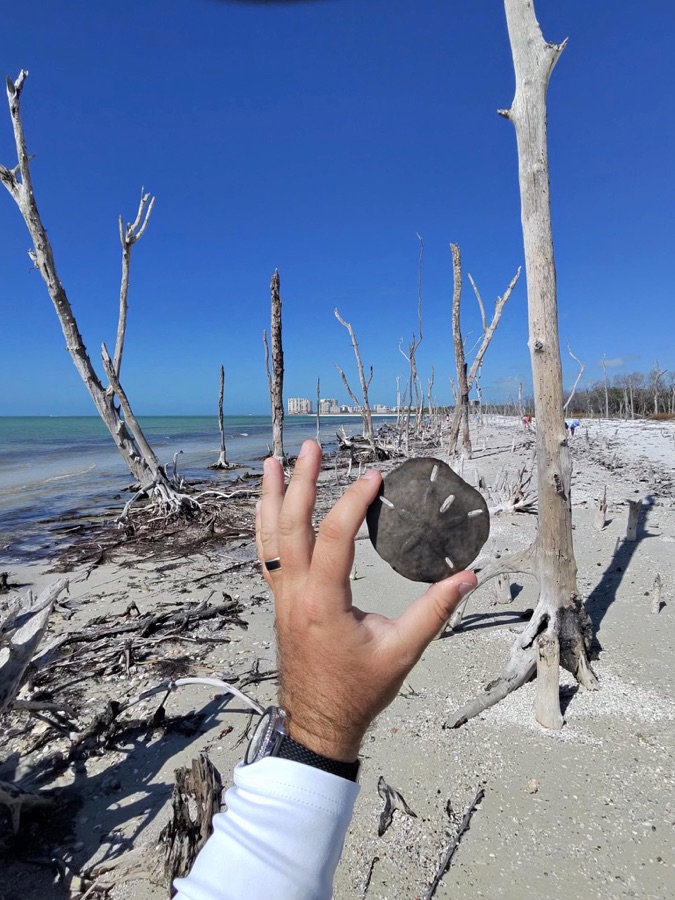
What makes a disc a Mellita rather than a cousin is those lunules. Five of them, enclosed, pierced through a test that is only about a millimeter thick. If you want the rest of the animal named part by part, that is the job of our anatomy page. This one is about the name, because the name is where nearly every source on the internet gets it wrong.
The short version
- The Gulf of Mexico five-slotted sand dollar is Mellita tenuis H. L. Clark, 1940, WoRMS AphiaID 422503, type locality Sanibel Island, ranging Louisiana to west Florida.
- Mellita quinquiesperforata (Leske, 1778) is the Atlantic species, Virginia to Brazil. It is a separate accepted species, not a synonym of Mellita tenuis.
- A Mellita has five lunules, the slots pierced through the test. Six means Leodia sexiesperforata, the six-holed keyhole urchin, WoRMS AphiaID 422502.
- Sand dollars are echinoderms, not mollusks, so MolluscaBase does not cover them. Echinoderm names live in the wider World Register of Marine Species.
- What the lunules are for is unsettled. Lift reduction and food transport are both argued, and neither is established.
- A beach-worn test often cannot be taken to species by eye. Mellita sp. is a legitimate identification to write on a label.
Count the Slots Before You Reach for a Name
Do this first. It is the only part of sand dollar identification that is genuinely easy. Hold the disc up to the light and count the openings that go all the way through it.
- None, and the thing is thick and domed rather than flat: that is a sea biscuit, genus Clypeaster. Clypeaster subdepressus is the flat sea biscuit and Clypeaster rosaceus is the one FWC calls the inflated sea biscuit. Same order, close kin, not sand dollars.
- Notches cut into the rim instead of clean enclosed slots: that is Encope. On Florida coasts the one to know is Encope michelini, whose US Fish and Wildlife Service common name is the Notched Sand Dollar. It occurs on both Florida coasts and Gulf-wide.
- Five enclosed slots: Mellita. This is the page you are on.
- Six: Leodia sexiesperforata, usually called the six-holed keyhole urchin. It runs North Carolina to Uruguay, Florida and the Gulf included.
Counting to five gets you to the genus. It does not get you to the species, and the species is exactly where nearly every page stops paying attention.
Mellita tenuis, the Animal on This Coast
Mellita tenuis H. L. Clark, 1940. The World Register of Marine Species carries it under AphiaID 422503. It ranges Louisiana to west Florida, which is to say the northern and eastern Gulf, which is to say here.
The detail worth carrying around is the type locality: Sanibel Island. A type locality is the place the original type specimen came from, the physical anchor the name is tied to. Every argument about what Mellita tenuis is refers back, in the end, to animals collected on a Gulf beach a couple of hours up the coast from Goodland. The Gulf's sand dollar was described from the Gulf.
The epithet reads plainly enough. Tenuis is Latin for thin or slender, which tells you what struck the person who described it. We are not going to teach you to use test thickness as a field character, because on a beach-worn disc it is not something a non-specialist can trust. But the word is a signpost to what the original description cared about.
Mellita quinquiesperforata, the Atlantic One
Mellita quinquiesperforata (Leske, 1778) is a different species living on a different coast. Its range runs Virginia to Brazil: the western Atlantic seaboard and south, not the Gulf beaches of southwest Florida.
Read the epithet and it explains itself. Quinquies, five times. Perforata, pierced. Five times pierced, which describes every animal in the genus, which is part of why the name slid so easily onto animals it does not belong to.
Now the sentence this page exists for. Mellita quinquiesperforata is not a synonym of Mellita tenuis. They are two accepted species, each with its own record and its own AphiaID in the World Register of Marine Species. Writing the Atlantic name on a Marco Island test is not a spelling preference and not an outdated-but-equivalent usage. It is another animal's name.
Why the Wrong Name Will Not Die
Five reasons, and not one of them is stupidity. Understanding why an error persists is the only way to stop repeating it.
Age. Leske named the Atlantic species in 1778. Clark named the Gulf one in 1940. That is a hundred and sixty-two years in which every book, drawer label, classroom and field guide that mentioned a five-slotted sand dollar anywhere in the western Atlantic used the older name, because for most of that time it was the only name there was.
Resemblance. They are congeners. Same genus, same flattened disc, same five lunules, same look on a dry table. Nothing about a bleached test announces which of the two it came from.
Copying. Popular writing copies popular writing. A name that already appears in ten thousand pages is the name the next writer reaches for, and there is no penalty at all for being wrong in a photo caption.
Default geography. Most American shelling content is either written for the Atlantic coast or written for nowhere in particular. The Gulf inherits the Atlantic name by default, the same way it inherits Atlantic tide advice.
Nobody checks. Getting this right means knowing that echinoderm names are not in the mollusk register, then finding the right one, then reading a distribution. That is three steps more than a caption usually gets.
What the Slots Are Actually For
Here is where the honest answer is less satisfying than the confident one. What the lunules are for is not settled.
Two explanations are in circulation and both are serious. The first is hydrodynamic. A flat disc sitting in moving water over sand generates lift the way a wing does, and a wing with holes in it generates less of it. On that reading the lunules are how the animal keeps from being picked up and rolled along the bottom. The second explanation is about food: the slots work with the food grooves on the underside as part of the plumbing that moves fine particles across the body toward the mouth at the center.
Those are not mutually exclusive. A structure is allowed to do two jobs. You will also find pages that state one of them flatly, as settled fact, and that goes further than the work does. We would rather hand you a real open question than a tidy wrong answer.
What the slots are definitely not is wounds. The legend that reads them as the five wounds of the crucifixion is old, widespread and of genuinely unknown authorship, and it has nothing to do with why the holes are there.
Size, Without a Number We Cannot Back
We are not going to give you a size range for Mellita tenuis, because we have not verified one against a primary source, and an invented measurement is exactly the kind of thing this page exists to argue against.
Qualitatively: an adult sits comfortably in a cupped palm. The test is thin, roughly a millimeter of fused plate, which is most of the reason a whole one is uncommon and a pocketed one often does not stay whole. A young animal is a small version of the same shape, not a different shape.
That last point does more work than it looks like it does. Sand dollars grow continuously, so the size of the disc in your hand is telling you roughly how old the animal got, not which species it belonged to. A small test is a young something. Anyone using size to separate two species in the same genus from a beach find is telling you a story.
Where They Live, and What a Bed Is
Sand, and specifically the top layer of it. A Mellita works itself down into the surface of a sandy bottom rather than crawling around on top of it, moved by spines and tube feet together, and it can sit edge-on into a current instead of presenting a flat face to the flow. Depth varies by species, from shallow water out to considerable depth.
They are also not scattered. Sand dollars live in dense aggregations, and in some populations those beds reach densities of hundreds per square meter. That is the normal condition for the animal: a bare test on the beach came from a crowd, somewhere out there.
Which leads to the only etiquette that matters. If you are ever standing over a bed, you are standing over a great many live animals whose skeleton is a millimeter thick. A bed is not something to walk through. There is more on how those aggregations work on our sand dollar beds page.
Why a Bare Test Tells You Less Than You Think
Now the part most pages skip. Once the animal is dead and the test has spent time in the swash, much of the information a specialist would use is simply gone.
Color is gone, and color was never diagnostic here anyway: white is what time does to a test, not what the animal was. The margin is worn, and the margin is where outline characters live. Lunules widen and their edges round off as sand works at them. Many tests are cracked along the sutures between plates before anything shows on the outside. And the specimen has moved. It drifted before you picked it up and you have no way to know how far.
So here is the admission this page is built around, stated without softening. A non-specialist usually cannot tell Mellita tenuis from Mellita quinquiesperforata by eye from a beach-worn test. This is not a matter of needing more practice. Often it is not possible with the specimen in hand. Someone with reference material, fresh specimens and a comparative series can do work that you cannot do standing on a sandbar with wet hands.
That is not a reason to give up on the question. It is a reason to change what you write down.
What the Beach Can and Cannot Settle
Locality is the strongest single piece of evidence a beachcomber has, and it is still not proof.
The reasoning is sound as far as it goes. Mellita tenuis ranges Louisiana to west Florida. Mellita quinquiesperforata ranges Virginia to Brazil. A five-slotted test picked up around Marco Island is, on range alone, far more likely to be Mellita tenuis, and that inference is a great deal better than copying the Atlantic name off a search result.
But notice what just happened. You identified the beach, not the specimen. That is an inference from a distribution map, and it can fail for ordinary reasons: published ranges get revised when people actually go look, individual tests drift, and a specimen that came out of a craft bag or a gift shop bin has no locality at all. Two sand dollars sold as Florida souvenirs, Echinarachnius parma and Dendraster excentricus, are a northern and a Pacific animal respectively and neither one occurs in Florida.
So say what you actually did. "A Mellita, and on range this coast has Mellita tenuis" is honest. "Mellita tenuis, determined from the test" is not, unless you determined it.
The Common Names Are Not Helping
Scientific names have rules, a register and a paper trail. Common names have none of that, and the sand dollar ones are looser than most.
- "Five-slotted sand dollar" is a description. It is accurate, and it points at a genus rather than a species.
- "Arrowhead sand dollar" is a vendor nickname, applied inconsistently across several Encope species. It is not a species name and it should not be handled like one.
- "Keyhole urchin" belongs to the usual common name of Leodia sexiesperforata, the six-holed keyhole urchin, which is a different genus entirely.
- "Inflated" belongs to Clypeaster rosaceus, the inflated sea biscuit, and a sea biscuit is not a sand dollar.
None of that is a reason to sneer at common names. People use them, and they are how most people meet an animal for the first time. It is a reason not to let a common name do work that only a scientific name can do, which includes telling you which side of Florida an animal lives on.
How to Record a Find You Cannot Name to Species
There is an established convention for exactly this situation, it is used in real collections, and adopting it costs you nothing.
- Mellita sp. means a sand dollar in the genus Mellita, species undetermined. It is a complete and respectable identification. Write it without embarrassment.
- Mellita cf. tenuis means this compares with Mellita tenuis. The "cf." is short for the Latin confer, compare. It records both that you leaned one way and that you did not settle it.
- Mellita tenuis, written bare, is a determination. Only write it if you actually made one.
Around the name, record what you observed rather than what you concluded: the date, the beach and the most specific position you can give, whether the animal was alive or already a bare test, whether it came off wet sand or dry, how many lunules you counted, and whether the test was whole. Photograph both faces before it breaks, because eventually it will. A specimen without a label is a decoration and a specimen with a label is data, which is the argument our shell collecting page is built on.
If you want another set of eyes, iNaturalist is where to put the photograph. Identifications left at genus level are normal there, and a specialist may come along and take it further. What you should not do is quietly upgrade a guess. Once "probably tenuis" gets copied onto a card as "tenuis", the doubt is gone and the record is simply false.
How to Check a Name Yourself
One point first, because it catches out careful people. MolluscaBase is the accepted authority for mollusk names, and it is the right tool for a whelk, a conch or a cockle. It does not cover sand dollars. A sand dollar is not a mollusk. It is an echinoderm, phylum Echinodermata, and MolluscaBase is mollusk-specific by design. Searching there for Mellita and coming up empty means you reached for the wrong register, not that the name is wrong.
The one you want is the wider World Register of Marine Species, of which MolluscaBase is one part. Search the name, then read the record rather than the headline:
- Status. Accepted, or unaccepted with a pointer to the name that replaced it.
- AphiaID. A stable number for the record. Mellita tenuis is 422503 and Leodia sexiesperforata is 422502. The numbers hold still even when names move.
- Authority and year. Clark, 1940 for tenuis. Note the parentheses on (Leske, 1778) for the Atlantic species: by convention, parentheses mean the species was first described in a different genus and has been moved since.
- Distribution. Which is what settles a Gulf-versus-Atlantic question faster than anything else on the page.
For specimens rather than names, the Florida Museum's invertebrate zoology collection is the regional reference. For the animal rather than its name, start at the sand dollar codex or the longer sand dollar overview.
And if you would rather ask a person than a database, that is what the ride back is for. We run three trips a day out of San Marco Marina in Goodland, and you can reserve a seat here.
Questions people actually ask
What is the correct scientific name for a Gulf of Mexico sand dollar?
The five-slotted sand dollar of the Gulf is Mellita tenuis H. L. Clark, 1940, carried in the World Register of Marine Species as AphiaID 422503 and described from a type locality at Sanibel Island. It ranges Louisiana to west Florida. Most sources, including field guides and museum labels, print Mellita quinquiesperforata instead, and that is the Atlantic species.
Is Mellita quinquiesperforata just another name for Mellita tenuis?
No. They are two separate accepted species, each with its own record in the World Register of Marine Species. Mellita quinquiesperforata (Leske, 1778) is the Atlantic animal, Virginia to Brazil. Mellita tenuis H. L. Clark, 1940 is the Gulf animal, Louisiana to west Florida. One is not a synonym or an older spelling of the other, so using the Atlantic name on a Gulf beach names the wrong species.
How do I know I am holding a Mellita and not something else?
Count the openings that go all the way through the disc. Five enclosed slots, called lunules, means Mellita. Six means Leodia sexiesperforata, the six-holed keyhole urchin. Notches cut into the rim rather than enclosed slots means Encope, and on Florida coasts that is Encope michelini, the Notched Sand Dollar. No openings at all, on a thick domed body, means a sea biscuit in the genus Clypeaster.
Can I tell the two Mellita species apart from a test I found on the beach?
Usually not, and it is better to say so. Beach wear rounds the margin, widens the lunules and strips the color, and the specimen drifted an unknown distance before you found it. A specialist with fresh material and a comparative series can work on it. Standing on a sandbar, you generally cannot. Record it as Mellita sp., or as Mellita cf. tenuis if you want to note which way you leaned.
Why can I not find Mellita in MolluscaBase?
Because a sand dollar is not a mollusk. MolluscaBase is mollusk-specific, so it covers whelks, conchs and cockles and stops there. Sand dollars are echinoderms, phylum Echinodermata, class Echinoidea. Their names live in the wider World Register of Marine Species at marinespecies.org, of which MolluscaBase is one part. An empty search there means the wrong register, not a bad name.
What are the five slots in a sand dollar for?
That is genuinely unsettled. One explanation is hydrodynamic: a flat disc in moving water generates lift, and holes through it reduce that lift so the animal is harder to pick up and roll. Another is about feeding, with the slots working alongside the food grooves that carry fine particles to the mouth. Both are taken seriously. Any page stating one of them as settled fact has gone past the evidence.
Where do these sand dollars actually live?
On sandy bottoms, worked into the top layer of sand rather than sitting on it, from shallow water out to considerable depth depending on the species. They live in dense aggregations, and in some populations those beds reach densities of hundreds per square meter. An animal that can sit edge-on into a current is doing so to stay put. A bed is a great many live animals, and it is not something to walk through.
Where this comes from
Every factual claim on this page traces to a published source. Where the science or the law is genuinely unsettled, we say so on the page rather than pick the tidier answer.
Come find them with us
Three trips a day out of Goodland, into water the road does not reach. Captain-led, family-friendly, and timed to the tide.